
Your driveway is one of the first things people notice about your home, and choosing the right surface can make a lasting impression. If you are a homeowner in the southeast of Ireland considering an upgrade, Waterford Tarmac Driveways are among the most popular and practical options available to you today.
Tarmac has earned its reputation for good reason. It is durable, cost-effective, and when installed correctly, it can transform the entire look of your property. But before you commit to any contractor or material, there are several important things you need to understand to make a confident, informed decision.
In this guide, we will walk you through everything a beginner homeowner should know about tarmac driveways in Waterford. From understanding what tarmac actually is, to knowing what questions to ask your installer, to learning how to maintain your new surface properly, this list covers all the essentials. By the time you finish reading, you will have a clear picture of what to expect and how to get the best possible result for your home.
Why Tarmac Works So Well in Waterford’s Climate
Waterford’s climate is not forgiving to poorly chosen driveway surfaces. The county receives significant annual rainfall, and seasonal frost is a regular feature of winter months across the South East. Surfaces that lack flexibility, such as concrete, absorb water and then crack as that water freezes, expands, and contracts repeatedly through the colder months. Tarmac behaves differently. Its bitumen-bound composition gives it a degree of flexibility that allows it to move slightly under freeze-thaw pressure rather than fracturing. According to research on asphalt and climate resilience, water-related damage accounts for nearly 90% of pavement failures, making moisture management the single most important factor in any driveway surface decision.
Beyond its structural flexibility, tarmac’s smooth, compacted finish sheds rainwater quickly and efficiently. Standing water has no opportunity to pool and refreeze overnight, which is one of the most common causes of slippery driveways and surface deterioration during Irish winters. The dark colour of tarmac adds another practical advantage; it absorbs solar heat during daylight hours, helping to clear frost and light ice faster than lighter-coloured alternatives such as concrete or resin.
Tarmac’s suitability for Irish conditions is not a new discovery. As noted in a detailed comparison of block paving versus tarmacadam for Irish weather, tarmacadam has long been the material of choice for large Irish driveways and roadways across the South East, valued for its proven performance in a temperate, wet climate. For Waterford homeowners specifically, this translates into a surface that performs reliably year after year without requiring seasonal sealants, protective treatments, or significant intervention to maintain its structural integrity through winter.
The Tarmac Driveway Installation Process, Step by Step
Understanding what actually happens on your driveway before, during, and after installation helps you ask the right questions and recognise quality workmanship when you see it. Here is the full process, broken down into six clear stages.
1. Site Assessment
Before a single shovel enters the ground, a professional contractor visits your property to assess existing ground conditions, drainage patterns, and how the driveway will be used. A surface intended to support daily vehicle traffic requires a fundamentally different specification than a pedestrian path. Drainage fall is also calculated at this stage, ensuring surface water runs away from your property rather than pooling. Getting this survey right sets the foundation for everything that follows.
2. Excavation and Removal
Existing surfaces, topsoil, and any unstable material are removed to a depth of typically 150mm to 250mm, depending on ground conditions and sub-base requirements. All spoil is cleared from site entirely. Shallow excavation is one of the most common shortcuts taken by inexperienced operators, and it almost always leads to surface rutting and settlement within a few years.
3. Sub-Base Compaction
A layer of Type 1 MOT stone is laid and mechanically compacted to form the structural core of your driveway. This is the most critical stage of the entire process. A properly compacted sub-base distributes vehicle load evenly, prevents sinking, and gives the tarmac above it a stable platform to bond with. According to Ward Education’s tarmac installation guide, two rounds of compaction are recommended for best results.
4. Kerb and Edging Installation
Concrete kerbs or edging units are set along the driveway boundary before tarmac is laid. These define the finished edge, contain the tarmac body during laying, and prevent lateral spreading over time. Edging also contributes to the overall appearance of the finished surface.
5. Binder Course and Wearing Course
A hot bitumen binder course is applied first, providing structural depth and adhesion. The wearing course of tarmac follows, spread and levelled to a consistent thickness across the full surface. As outlined in Harrington Brothers’ driveway installation guide, each layer serves a distinct structural purpose and neither should be rushed.
6. Mechanical Rolling
A heavy mechanical roller passes over the full surface, compacting the tarmac to the required density, eliminating air pockets, and producing the smooth, uniform finish tarmac is known for.
A complete residential tarmac driveway installation in Waterford can be finished in as little as three days, causing minimal disruption to your household routine.
How Much Does a Tarmac Driveway Cost in Waterford?
Tarmac driveway pricing in Waterford is not a fixed figure, and understanding what drives the final cost will help you budget accurately and avoid surprises. Four key variables determine your overall investment: the total area in square metres, the current condition of the ground beneath, how accessible your site is for machinery, and whether additional groundworks such as drainage or kerbing are required.
As a general guide for the Irish market in 2026, residential tarmac driveways typically range from approximately €40 to €70 per square metre, fully installed. Smaller driveways often sit at the higher end of that range because contractors face fixed setup and mobilisation costs regardless of project size. A compact single-car driveway of 30 square metres will cost more per metre than a 70 square metre double driveway, even though the total spend is lower. According to Selfbuild Ireland, €50 per square metre is a useful starting point for Irish budgeting, but final costs depend heavily on site conditions.
Excavation and sub-base preparation is usually the single largest cost driver on any project. If the existing ground is stable, well-compacted, and properly drained, a tarmac overlay can reduce costs considerably. If a full dig-out is needed, along with the removal of soil, debris, and the installation of new hardcore, your total project cost will increase accordingly. This step cannot be skipped without compromising the finished surface.
Additional features including decorative edging, drainage channels, dropped kerbs, and tar and chip finishing will add to the base cost. However, these upgrades often extend driveway lifespan and improve the overall appearance of your property significantly.
Always request a written, itemised estimate rather than accepting a verbal figure. Reputable Waterford contractors, including Extreme Driveways and Patios, offer free, no-obligation site assessments so you can review costs clearly before making any commitment.
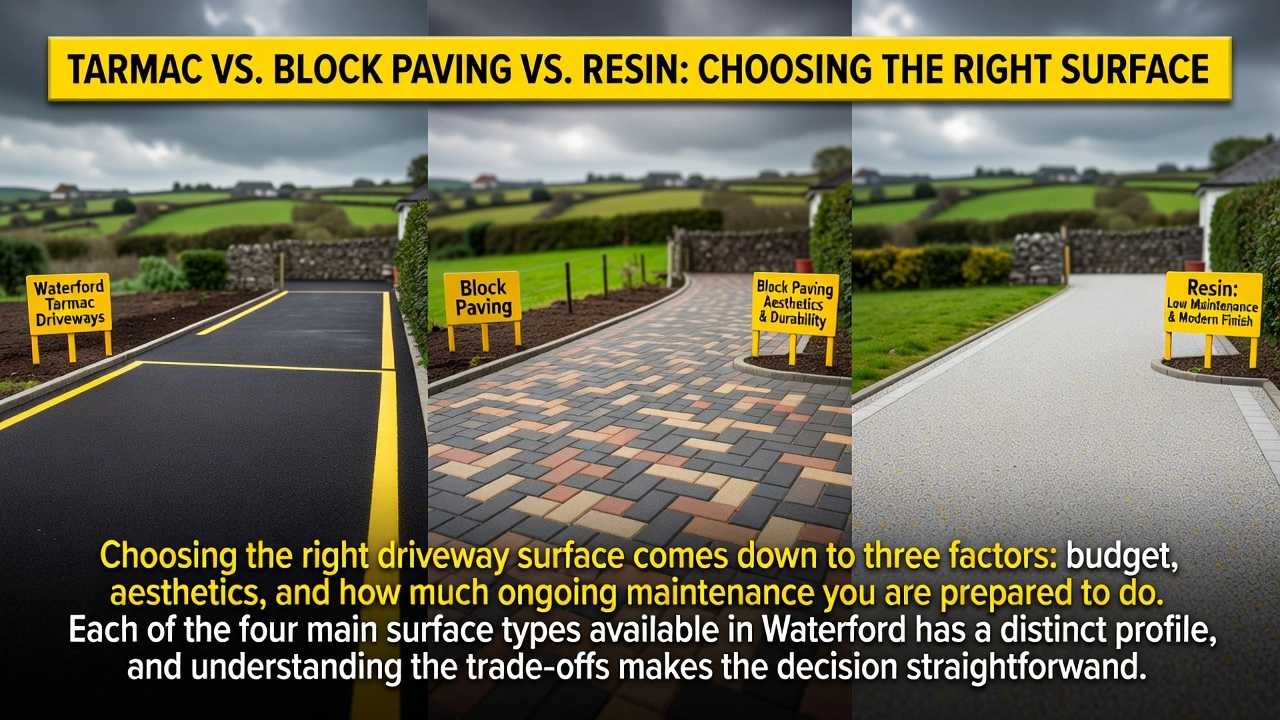
Tarmac vs. Block Paving vs. Resin: Choosing the Right Surface
Choosing the right driveway surface comes down to three factors: budget, aesthetics, and how much ongoing maintenance you are prepared to do. Each of the four main surface types available in Waterford has a distinct profile, and understanding the trade-offs makes the decision straightforward.
Tarmac is the most cost-effective upfront choice for larger driveways, particularly those of 40 square metres or more. It installs quickly, typically within a few days, and requires very little maintenance over its lifespan. The main limitation is visual; tarmac is primarily available in black, which suits many homeowners but offers limited scope for customisation. Tar and chip finishes address this by pressing natural aggregate into a tar base, creating a textured surface with colour variation that sits at a lower price point than full resin. This option is particularly popular across rural Waterford, where a more natural, landscape-friendly appearance is preferred.
Block paving offers the greatest design flexibility of any solid driveway surface. With a wide range of colours, patterns, and finishes available, it can be tailored to complement almost any property style. A practical advantage specific to block paving is that individual units can be lifted and relaid if access to underground utilities is ever required. The trade-offs are a higher cost per square metre than tarmac, and the need for periodic joint re-sanding to prevent weed growth taking hold over time.
Resin-bound surfaces deliver a premium, highly attractive finish and are fully permeable, meaning rainwater drains through the surface rather than running off. This complies with sustainable urban drainage requirements and makes resin a strong choice for front driveways. It is, however, the most expensive option per square metre, and installation conditions need to be carefully managed to achieve a durable result. For a useful visual comparison of all three surfaces, this resin bound vs block paving vs tarmac breakdown covers the core differences clearly.
For most Waterford homeowners weighing value, speed of installation, and long-term durability with minimal upkeep, tarmac remains the consistently practical choice. Extreme Driveways and Patios installs all four surface types, and a no-obligation site visit allows the right recommendation to be made based on your specific property, drainage conditions, and budget.

How Long Does a Tarmac Driveway Last and How Do You Maintain It?
A well-installed tarmac driveway is one of the most durable surfaces available to Waterford homeowners. When laid on a properly compacted sub-base, you can expect a lifespan of between 15 and 25 years before full resurfacing becomes necessary. That range is not fixed; it shifts significantly based on the quality of the original installation, how much traffic the surface carries, and how consistently you carry out basic upkeep. Poor installation, particularly a weak or uneven sub-base, can cut that lifespan to under 12 years. Investing in quality from the outset is always the more economical long-term decision.
1. Seal cracks before they spread
Crack sealing is the single most important maintenance task you can perform. Small cracks allow water to penetrate the base layer, and once moisture is present, Waterford’s wet winters accelerate the damage through repeated freeze-thaw cycles. A hairline crack left untreated becomes a pothole within a few seasons. Inspect your driveway annually and fill any cracks as soon as they appear, typically every five to ten years depending on use. The cost is minimal compared to the expense of early resurfacing. According to research on asphalt driveway longevity, consistent maintenance can extend surface life by a decade or more.
2. Sealcoat every three to five years
Applying a bitumen-based sealant to the surface restores the fresh black appearance and provides a protective barrier against UV exposure, oil spills, and water ingress. For residential driveways, sealcoating every three to five years is the standard recommendation. It is a low-cost, straightforward job that delivers a disproportionate return in terms of extended surface life. Research into how long sealcoating and crack filling last confirms that sealed surfaces can outlast unsealed ones by ten to fifteen years.
3. Protect fresh tarmac during the curing period
New tarmac remains slightly pliable for up to six to twelve months after installation while it fully cures and hardens. During this period, avoid placing concentrated point loads on the surface. Motorcycle kickstands, skip bag supports, and heavy vehicle jack stands can all cause indentations, particularly on warm days when the surface softens slightly. These marks are permanent once the tarmac sets.
4. Manage weed growth at the edges
Weeds rarely break through the tarmac surface itself, but they can emerge at the edges where the driveway meets soil or lawn. Left unchecked, root systems can undermine the kerb line and lift the surface. Applying a residual weedkiller to the margins once or twice per year is sufficient to prevent this.
5. Simpler maintenance than block paving
Compared to block paving, which requires periodic re-sanding of joints and individual block replacement when damage occurs, tarmac upkeep is notably more straightforward and less costly across the full driveway lifespan. For most homeowners, annual inspections and occasional sealcoating is all that is required.
Do You Need Planning Permission for a Tarmac Driveway in Waterford?
The good news for most Waterford homeowners is that a standard tarmac driveway installation does not require planning permission. Under Irish planning regulations, driveway works within the curtilage of a private dwelling house are classified as exempted development, meaning no formal planning application is necessary. This exemption applies as long as the driveway serves a single residential property and does not involve unauthorised alterations to a public road or footpath. You can verify your specific circumstances using the Irish Planning Check tool, which provides instant guidance based on your situation.
However, there is a critical condition that many homeowners overlook. Since 2008, Irish planning regulations have required that surface water from any new driveway must not discharge directly onto the public road or footpath. For tarmac driveways of 25 square metres or more, this means you must incorporate an on-site drainage solution; options include grading the surface toward a lawn or soakaway, installing a channel drain connected to a private soakaway, or connecting to an existing surface water drain on the property. Driveways under 25 square metres are exempt from this drainage condition entirely. A reputable contractor will address drainage compliance during the initial site assessment, as this guide on planning permission for driveways in Ireland confirms is standard professional practice.
Two additional situations require careful attention before work begins. First, if your property is a protected structure or falls within an Architectural Conservation Area, which includes several historic streetscapes in Waterford city, exempted development status may not apply. In these cases, you should contact Waterford City and County Council’s planning department before any work proceeds. Second, creating or widening a vehicle entrance onto a public road requires a separate licence from the Council’s roads section, entirely distinct from planning permission. This application is made by the homeowner rather than the contractor, and typically costs between €200 and €400 in Waterford. A good contractor will guide you through the process.
Always confirm your exemption status before works begin. Carrying out works that require permission without obtaining it can result in enforcement action and costly remediation.
Areas We Cover for Tarmac Driveways Across Waterford
Extreme Driveways and Patios operates across Waterford city and county, covering a wide service area that includes Waterford city centre, Tramore, Dungarvan, Dunmore East, Kilmeaden, and Carrick-on-Suir. We also serve a broader range of South East locations including Passage East, Portlaw, Lismore, Tallow, and the wider Suir Valley corridor. If you are unsure whether your property falls within our service area, contact us directly and we will confirm promptly.
Being a genuinely Waterford-based contractor gives us a clear practical advantage over non-local operators. We can respond quickly for site visits and estimates, we understand the specific ground conditions found across the county, and we are familiar with Waterford City and County Council requirements around drainage and driveway construction. Our knowledge of local weather patterns, including the frost and rainfall that regularly affect the South East, also informs how we prepare sub-bases and specify materials on every project.
Our team handles the full range of property types across Waterford. Urban and city projects tend to involve compact driveways with straightforward excavation and kerb work. Rural entrance ways, by contrast, often require substantial groundworks, drainage design, and deeper excavation before any surface is laid. Whether your project is a modest suburban driveway or a large rural entrance, we bring the same standard of workmanship and local accountability to every job we take on.
Why Waterford Homeowners Choose Extreme Driveways and Patios
With 27 tarmac driveway services listed for the Waterford area, choosing the right contractor takes more than a quick Google search. Here are five reasons Waterford homeowners consistently turn to Extreme Driveways and Patios.
- We are genuinely based in Waterford. Several contractors listing Waterford as a service area operate from outside the county entirely. A locally based team means faster site visits, direct accountability, and real familiarity with local ground conditions, access logistics, and the specific demands of Waterford properties.
- One contractor handles everything. From initial excavation and drainage installation through sub-base compaction to the final tarmac roll, we manage the complete project. You make one call, deal with one team, and avoid the scheduling risk and cost overruns that come with coordinating multiple trades across a single job.
- We work across multiple surface types. Our portfolio covers tarmac driveways, block paving, resin surfaces, patios, and commercial installations. That breadth means we recommend what genuinely suits your property rather than defaulting to whatever one product we happen to specialise in.
- Our work is backed by verifiable social proof. Customer reviews and completed project references are available on request. In a market where star ratings and review volume are the primary way homeowners assess contractor credibility, we stand behind our results with transparent, real-world evidence.
- Written, itemised quotes as standard. Free site estimates are expected across the Waterford market. What sets us apart is the quality of what follows: a clear, written, itemised quote you can review at your own pace, compare honestly, and rely upon without pressure.
Ready to Get Started? Here Is What to Do Next
Taking the next step is straightforward. Contact Extreme Driveways and Patios to book your free, no-obligation site estimate. A member of our team will visit your property, assess existing ground conditions, discuss your preferences, and provide a written itemised quote covering materials, labour, groundworks, drainage, and kerbing as separate line items so you know exactly what you are paying for.
To help us deliver the most accurate estimate possible, take a few minutes beforehand to note the approximate size of your driveway area, your preferred surface type (or simply ask us to walk you through a comparison), whether a dropped kerb will be required, and any drainage issues you have noticed. These details allow us to assess your project properly from the moment we arrive.
If you are considering improvements beyond your driveway, ask about our full range of services including block paving, resin surfaces, patios, and groundworks. Many Waterford homeowners choose to address multiple areas of their outdoor space within a single project, saving time and cost on mobilisation.
With installations completable in as little as 3 days and a team covering all of Waterford city and county, a new tarmac driveway before the next season is entirely within reach. Get in touch with our team today or request a free estimate to understand what a quality installation involves in your area.
Conclusion
A tarmac driveway is one of the smartest investments you can make as a homeowner in Waterford. To recap the key points: tarmac is a durable and cost-effective surface, proper installation makes all the difference to its longevity, and regular maintenance will keep it looking great for years to come. Choosing the right local contractor is just as important as choosing the right material.
Now that you are armed with the knowledge to make a confident decision, the next step is yours to take. Reach out to a reputable Waterford tarmac specialist, ask the right questions, and get a few quotes before committing. Your driveway sets the tone for your entire home. With the right approach, you can boost your kerb appeal, add real value to your property, and enjoy a surface that works hard for you every single day.